CAPiTA Mercury Snowboard
$594.99Sanction Skate & Snow + others
Best overall for this brief: a directional hybrid-camber board designed around all-mountain and freeride versatility rather than one narrow snow condition.
AI visibility for Shopify
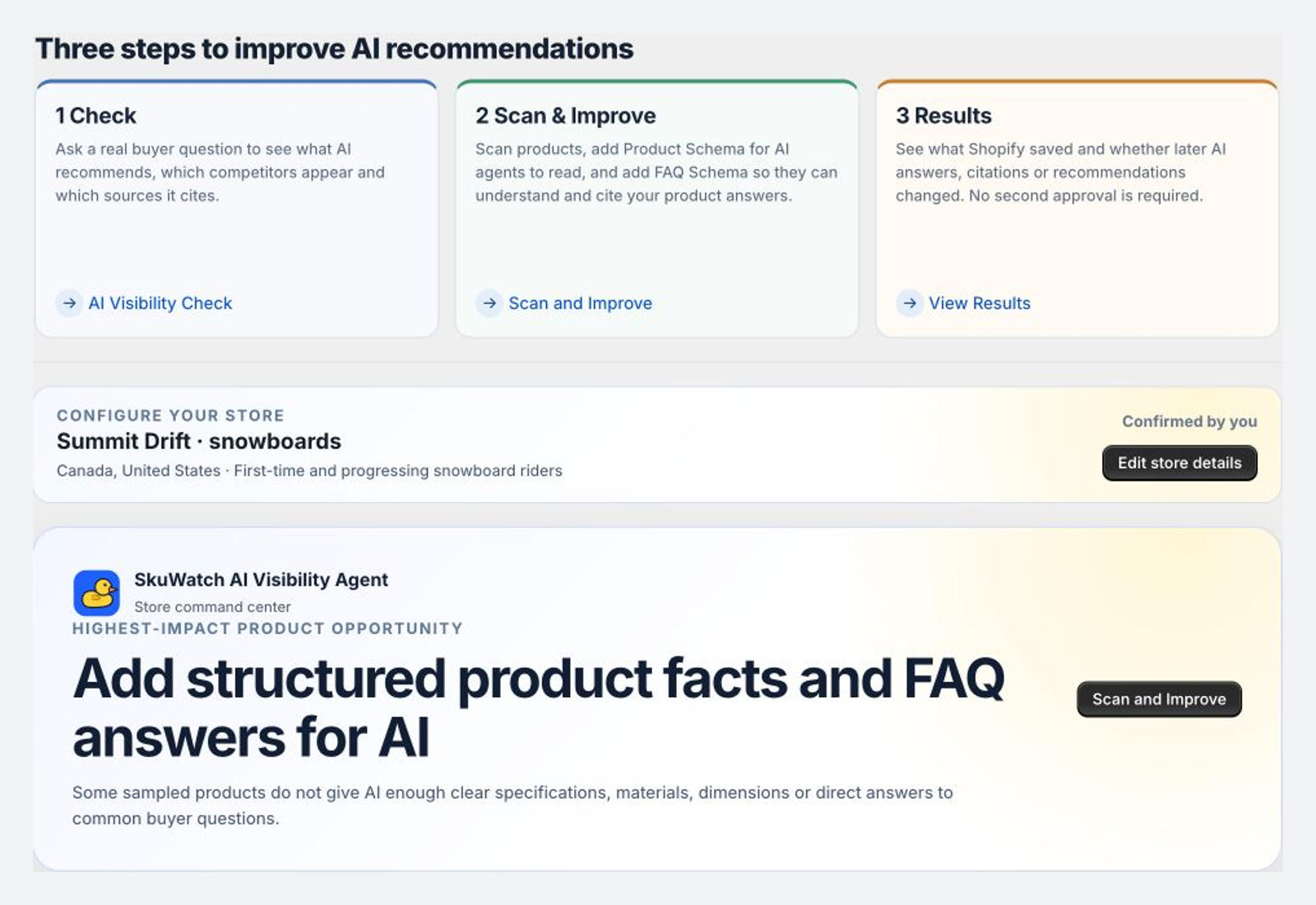
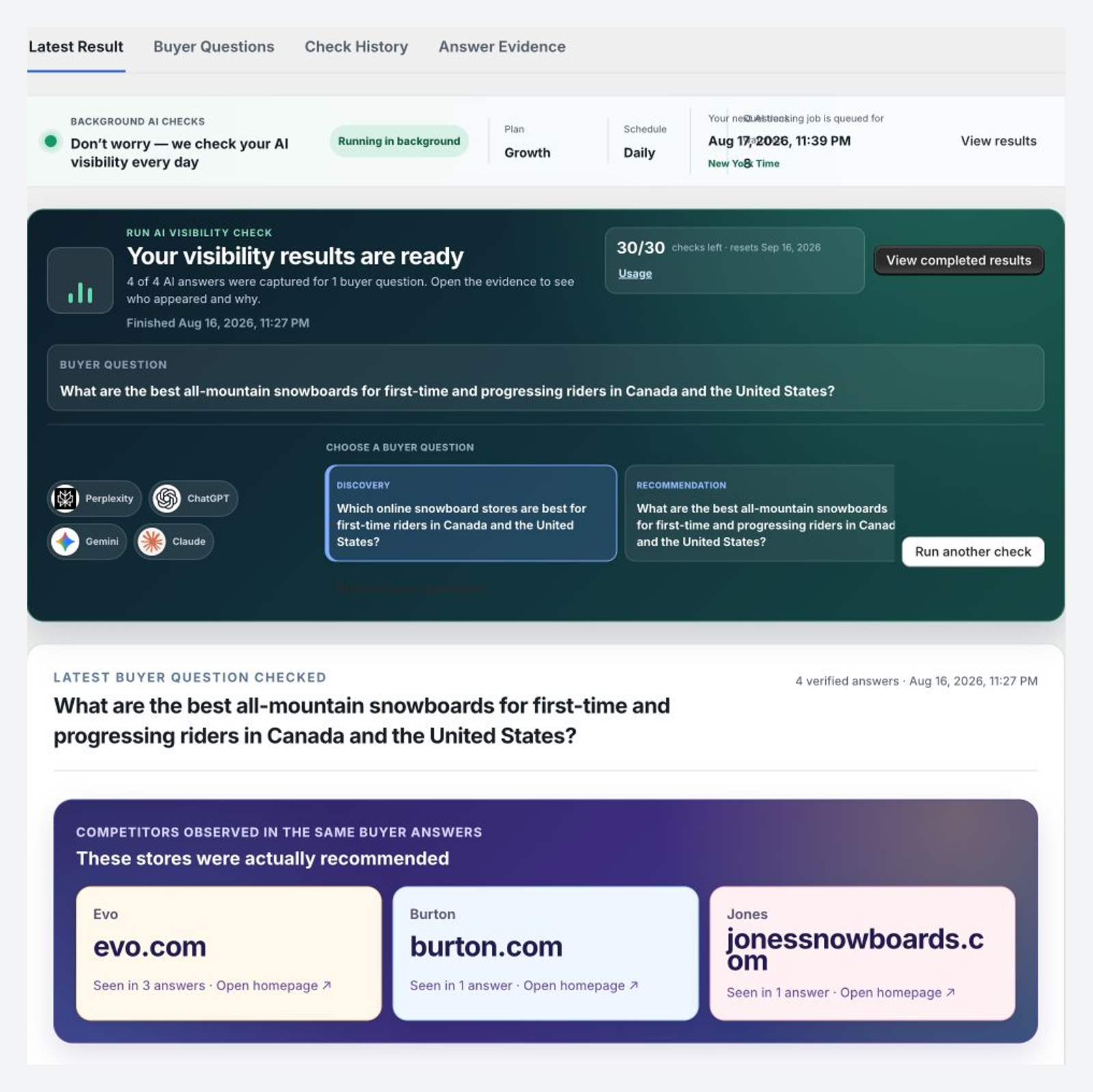
SkuWatch AI Visibility Agent monitors whether your Shopify products can be retrieved, understood, compared, cited, and kept accurate across AI shopping journeys. It explains the Shopify-level cause, proposes a controlled fix, verifies fresh evidence, and tracks what changed.
Public storefront check · No Shopify login · No theme access. Evidence stays inspectable and ranking outcomes are never guaranteed.
Run an initial retrieval and storefront signal check. No Shopify login or theme access required.
Built for real product catalogs
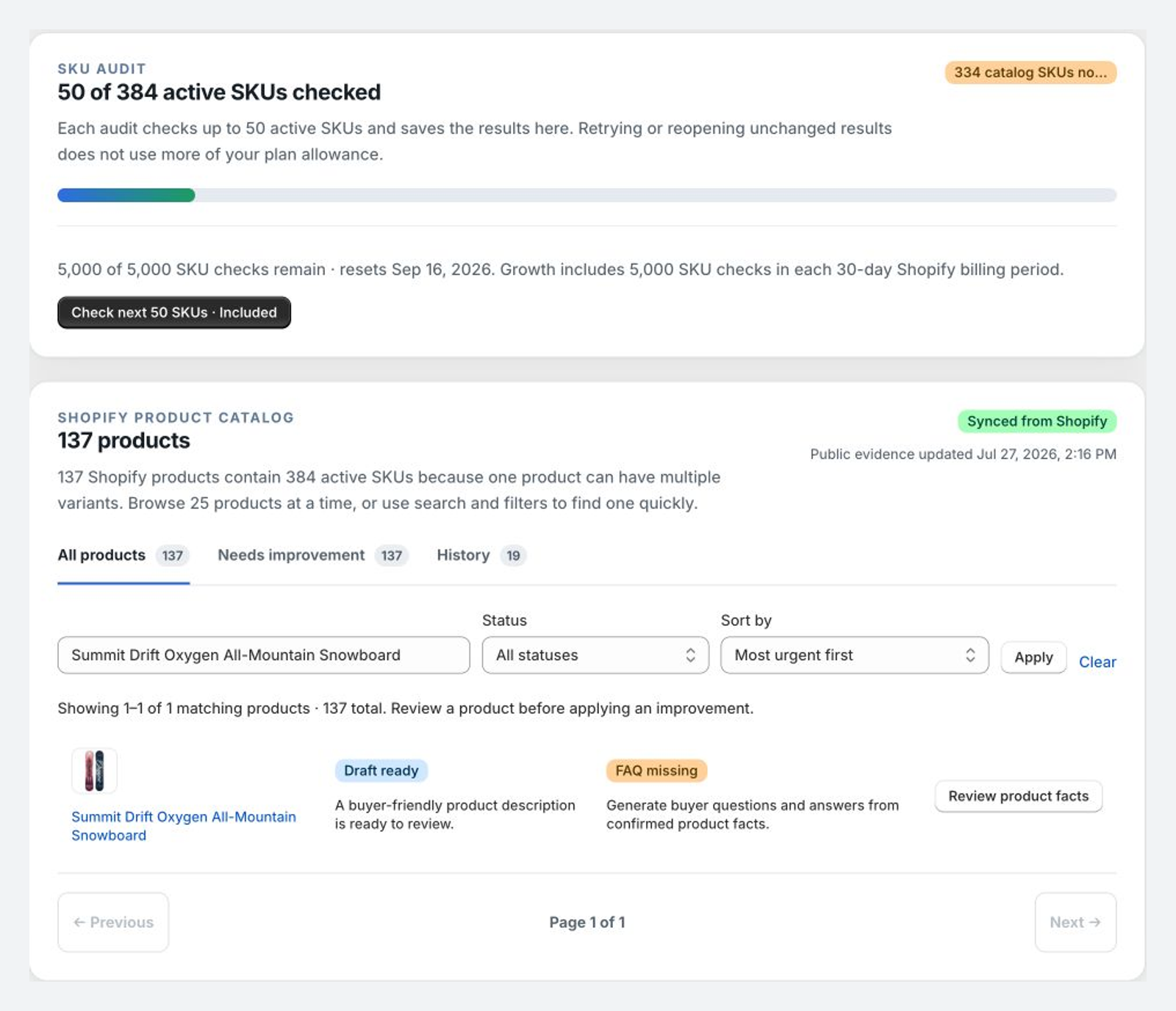
Images attract the buyer. Explicit facts help an agent understand what the product is, who it is for, and when it should be recommended.
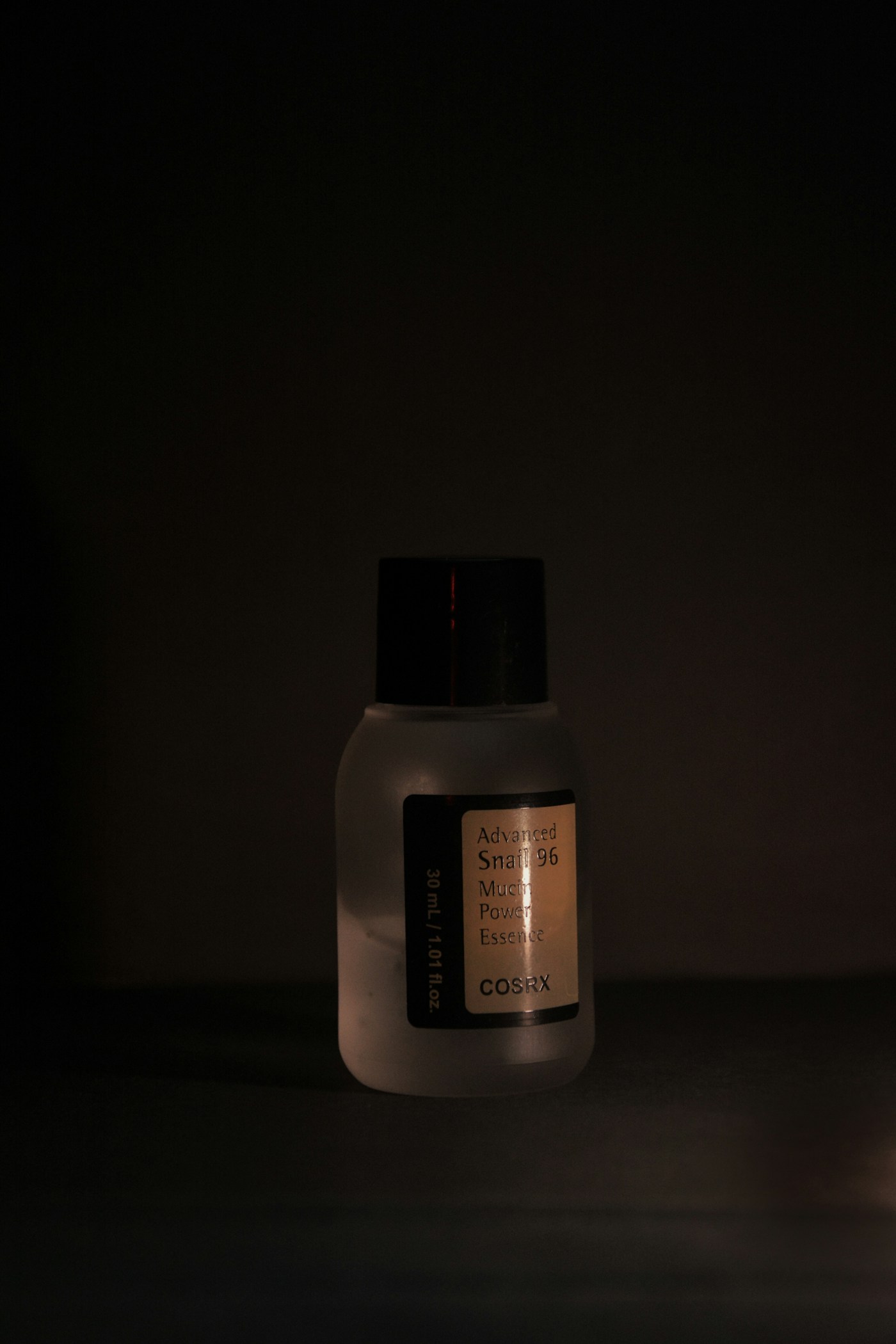
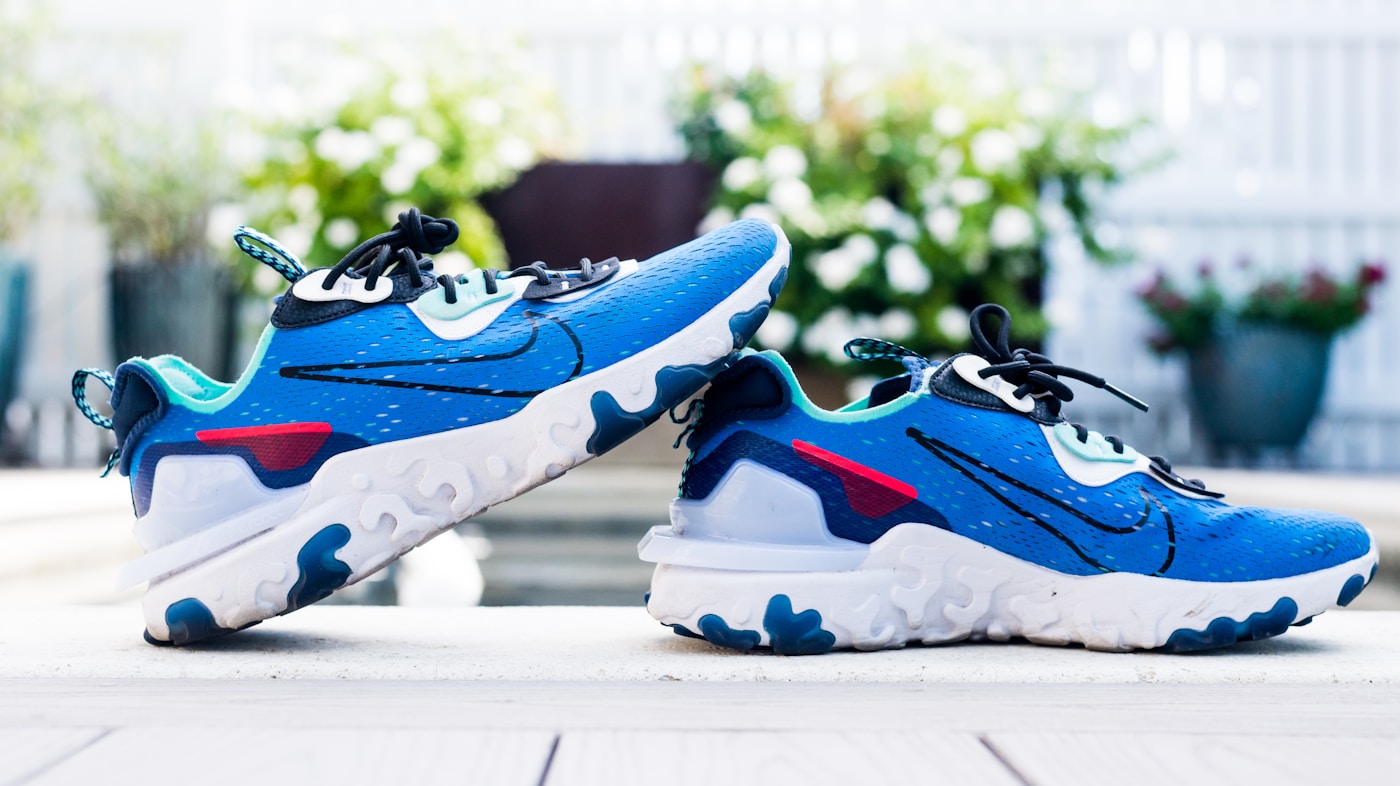
Product photography: Tasim Ahmed Safat, Julian Myles, Cooker King, and Content Pixie on Unsplash.
Inside ChatGPT product discovery
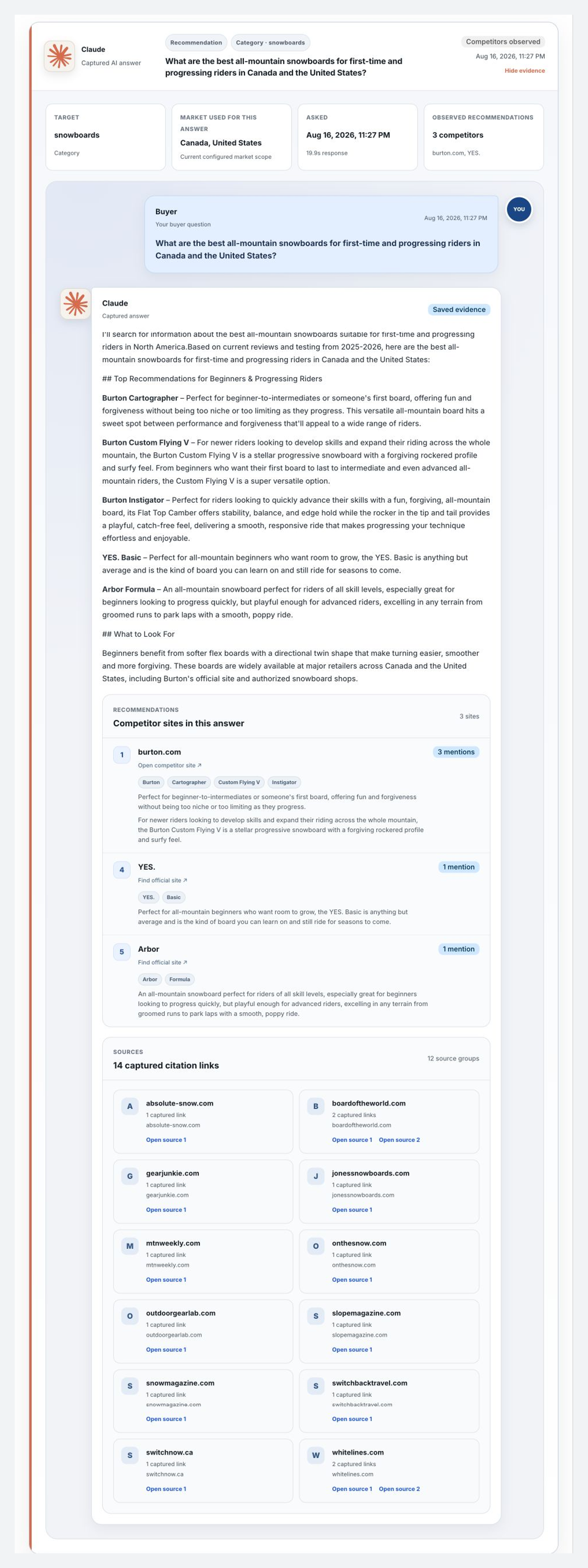
A useful shopping answer resolves one rider's terrain, ability, style, and budget constraints, then separates the strongest match from credible alternatives.
I'm an advanced rider looking for one all-mountain snowboard for Alberta and BC resort days: groomers, trees, side hits, and occasional powder. I want stability at speed without buying a powder-only board. Budget is about C$600.
The CAPiTA Mercury is the strongest fit for a rider who wants one directional all-mountain and freeride board with high-speed edge hold, powder float, and enough versatility for side hits.
Sanction Skate & Snow + others
Best overall for this brief: a directional hybrid-camber board designed around all-mountain and freeride versatility rather than one narrow snow condition.
PRFO Sports + others
Great if you ride powder and trees but still want versatility.
Sporting Life + others
A smooth all-mountain freeride board that's very forgiving.
Sport Chek + others
Balances big-mountain stability with all-mountain maneuverability and a medium, more forgiving feel.
Prices shown in CAD from the supplied result. Price, rating, seller, size, and stock can change; verify them on the merchant page before buying. Product images link to brand pages.
The channel shift is already operational
This is not only a new content format. Catalogs, citations, product attributes, availability, carts, and checkout are becoming agent-readable infrastructure.
Shopify reported nearly 13x year-over-year growth in AI-referred orders and more than 8x growth in chatbot referral sessions in Q1 2026.
Read the sourceOpenAI Commerce documents structured product feeds and checkout flows, while Shopping Research compares current product evidence.
Read the sourceMerchant Center documents AI performance insights and conversational product attributes for eligible accounts and markets.
Read the sourceThe agent commerce blind spot
There is no unified cross-platform console explaining why a product was omitted, misread, replaced, or cited from the wrong source.
An important SKU can stop appearing for a buyer question while a competitor takes its place, with no notification to the merchant.
Price, stock, compatibility, market, and variant identity can diverge across Shopify, the page, structured data, feeds, and retrieval caches.
The competing product may be easier to retrieve, compare, verify, and purchase, even when your page has stronger visual design.
Without fixed prompts, release history, evidence, and defined windows, a later mention cannot be connected responsibly to one edit.
One concrete product problem
The Loop is an operating method, not five words arranged in a diagram.
Signal House / DockPro 12-in-1
The canonical product page was not cited. Competing docks explicitly stated their Apple-silicon display limitations.
The page says "dual 4K" but does not state that DisplayLink software is required for this host configuration.
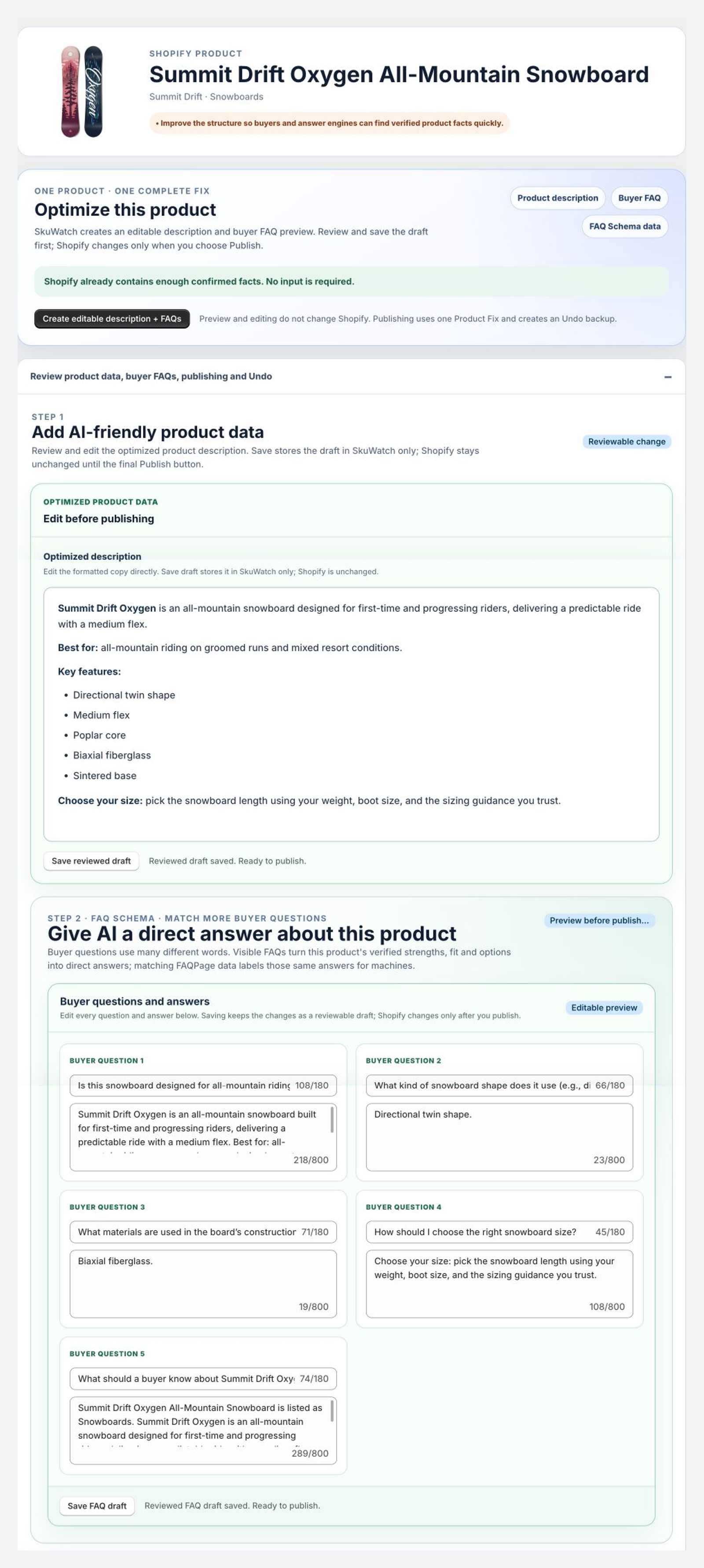
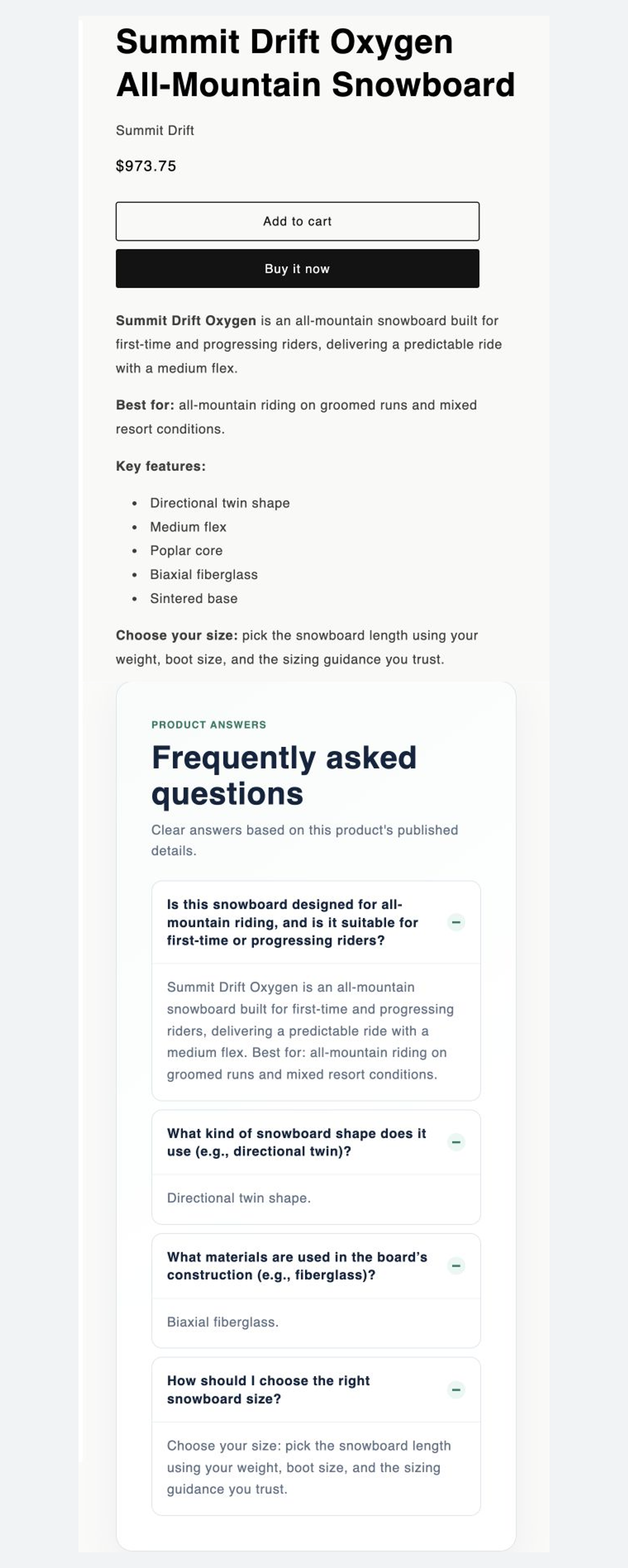
Add the limitation to visible specifications, compatibility metafields, and documentation; verify the selected model and rerun the same prompt.
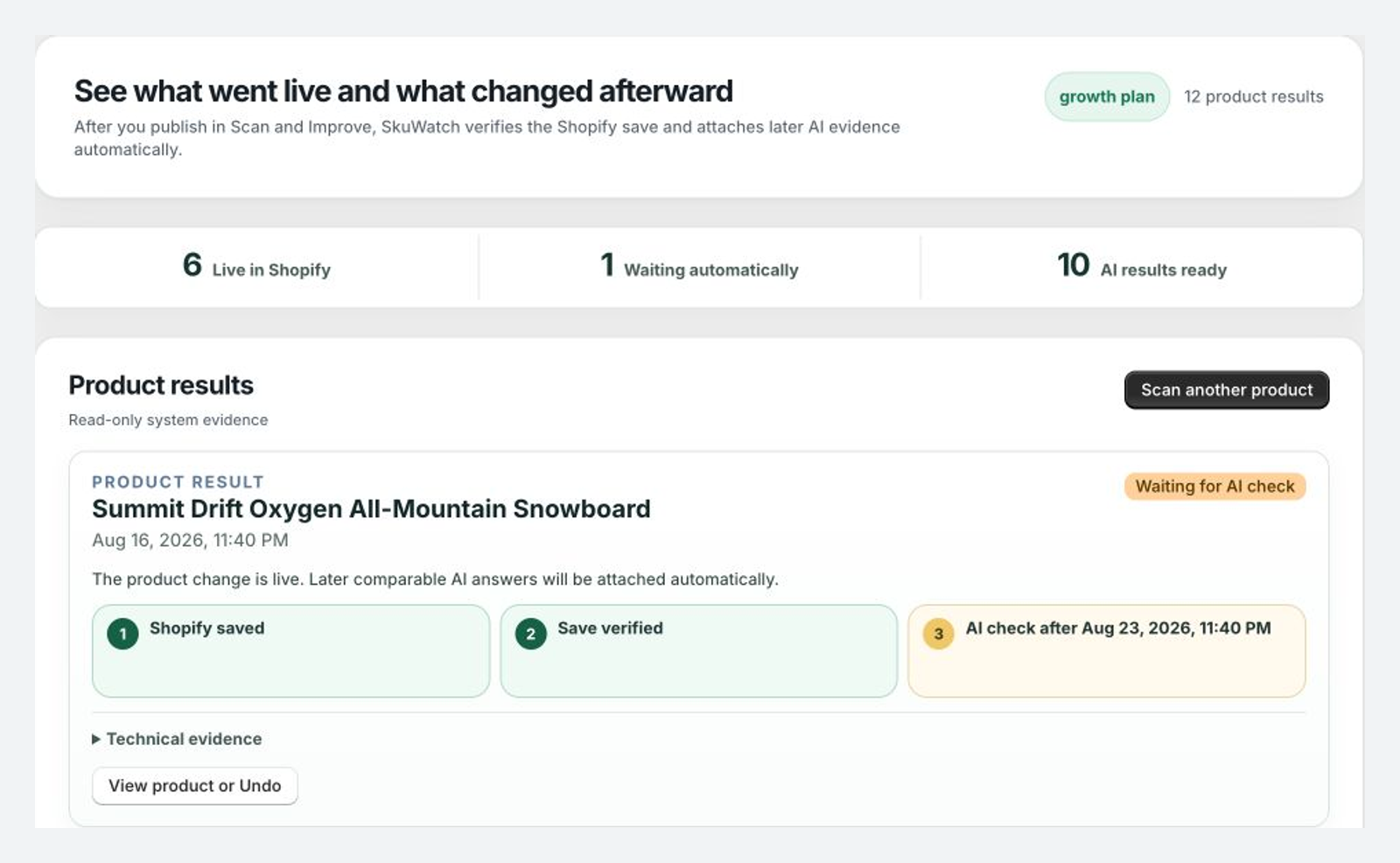
Attribute: if a later answer uses the corrected limitation or cites the canonical page, SkuWatch AI Visibility Agent connects that observation to the release. It still does not call temporal association proof of universal causation.
Not one general-purpose bot
Tool access, product context, evidence requirements, approvals, and retry boundaries remain explicit at each stage.
Maintains run state, assigns bounded tasks, checks evidence, requests approval, and prevents unsafe stage skipping.
Maps Shopify products, variants, markets, pages, feed records, prompts, cited URLs, and competitors into one graph.
Compares buyer intent with catalog, storefront, platform, source, and competitor evidence to rank possible causes.
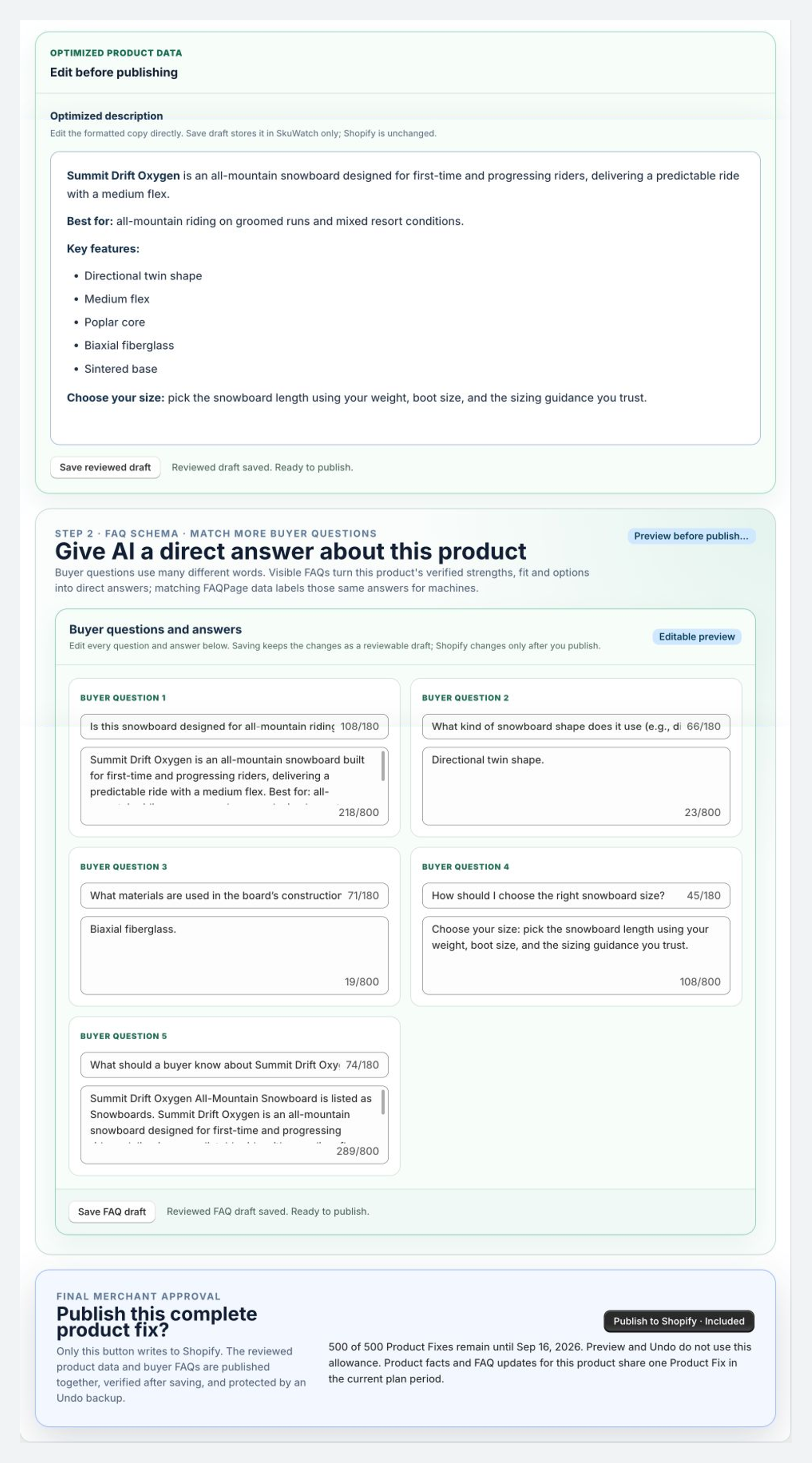
Separate proposals, merchant approval, bounded Shopify tools, prior values, execution records, and rollback.
Uses fresh retrieval and the saved test contract rather than accepting the executor's completion message.
Builds comparison windows and reports only the level of association supported by the available evidence.
Start with your operating problem
Separate retrieval, comparison attributes, first-party evidence, commerce state, and platform behavior.
WRONG FACTFollow one variant across Shopify, the page, Offer data, feeds, markets, caches, and observation time.
ATTRIBUTIONConnect releases and completed prompt runs without hiding other material events or provider failures.
Agentic without uncontrolled autonomy
SkuWatch AI Visibility Agent is designed around merchant control rather than invisible bulk edits.
Least privilegeEach agent receives only the stores, objects, and tools required for its task.
Evidence requiredA finding needs a URL, field, source, time, observed value, and method before it becomes a proposal.
Human approvalConsequential product, claim, Theme, feed, and policy changes remain reviewable.
Recoverable writesPrior values, backups, actor, deployment, and rollback remain attached to the change.
Independent verificationThe verifier checks public effects instead of trusting the write result.
Honest attributionObserved associations remain separate from claims of guaranteed ranking or causation.
The technical knowledge behind the product
Prioritization, product facts, launches, Theme changes, weekly routines, app decisions, and measurement.
AEO & GEOAnswerability, citations, recommendation logic, product feeds, agentic commerce, and visibility measurement.
TECHNICAL GUIDESShopify paths, Liquid, JSON-LD, identifiers, feeds, crawler access, expected output, risk, and rollback.
PLATFORM WATCHDated, primary-source updates across ChatGPT, Claude, Shopify, Google, and AI commerce infrastructure.
Straight answers
AEO and GEO introduce new terminology, but the merchant decision remains practical: can an AI system find the right product, understand it, compare it, and keep the commerce facts accurate?
AI visibility describes whether a store and its products can be retrieved, understood, cited, compared, and recommended in relevant AI-assisted shopping journeys. It includes crawler access, product identity, structured data, factual content, current commerce state, source authority, and observed answers.
SEO usually focuses on ranking pages in search results. AEO focuses on making information answerable and citable. GEO focuses on how brands and products appear in generated answers. They overlap, but AI shopping also depends heavily on resolvable product facts, variants, availability, source consistency, and comparison context.
The public scan checks available crawler policy signals, product-page access, Product and Offer structured data, and factual product-description quality. It reports which checks succeeded, which were unavailable, the evidence found, and the next actions. It does not require a Shopify login or theme access.
A store, CDN, bot policy, password wall, network response, or page-discovery path may prevent one or more checks. SkuWatch excludes unavailable categories from the observed calculation, displays coverage separately, and does not present that partial result as a complete store score.
No. Providers control retrieval, ranking, generation, and product experiences. SkuWatch improves the merchant's ability to observe and repair relevant technical and content signals, then verify what changed. It does not promise a ranking, citation, mention, or sale.
Public scans make no store changes. In the product workflow, consequential edits remain bounded, reviewable, and merchant-approved. Proposed changes retain evidence, prior values, execution records, and rollback context.
The operating loop monitors the affected product, explains the likely root cause, proposes a controlled fix, verifies fresh evidence after release, and records the outcome without overstating causation. This closes the gap between a visibility alert and a defensible Shopify action.
Start with a public storefront diagnostic, then see how SkuWatch AI Visibility Agent turns findings into an explainable Shopify operating loop.